
Most businesses are not short on marketing activity.
They’re short on structure.
This is especially common among service businesses in Columbus and across Ohio that rely on activity instead of architecture. The pattern is not unique to this market, but it is highly visible here.
They post. They redesign. They run ads. They experiment with new platforms. On paper, it looks like consistent effort. In reality, very little of it compounds.
When results stall, the instinct is to add more. More content. More spend. Another tactic.
But the problem is rarely effort.
It is that the activity is not part of a system designed to build on itself.
Marketing only creates momentum when each action reinforces the next. Without structure, every initiative starts from zero; regardless of how much work went into it.
This is one of the core reasons why most marketing plans fail over time, and why real growth strategies look fundamentally different from a list of tactics.
This article is part of our broader Growth Systems Framework, which explains how visibility, credibility, and conversion are engineered to compound over time.
Marketing tactics are individual actions.
Posting content. Running ads. Redesigning a page. Launching a campaign.
Marketing strategy is the structure that determines how those actions reinforce one another.
A tactic can generate motion.
A strategy generates direction.
Without structure, tactics operate independently.
With structure, tactics build on top of previous effort.
That distinction determines whether marketing compounds or resets.
Marketing activity creates motion.
Structure creates direction.
It is easy to mistake movement for progress. Publishing a post, launching a campaign, or updating a page produces visible action. Something was done, which creates the feeling that growth should follow.
But motion alone does not create momentum.
Structure is what allows effort to stack. It defines how each action supports the next, how signals reinforce each other, and how visibility builds over time.
Without that framework, marketing becomes a series of disconnected tasks instead of a system.
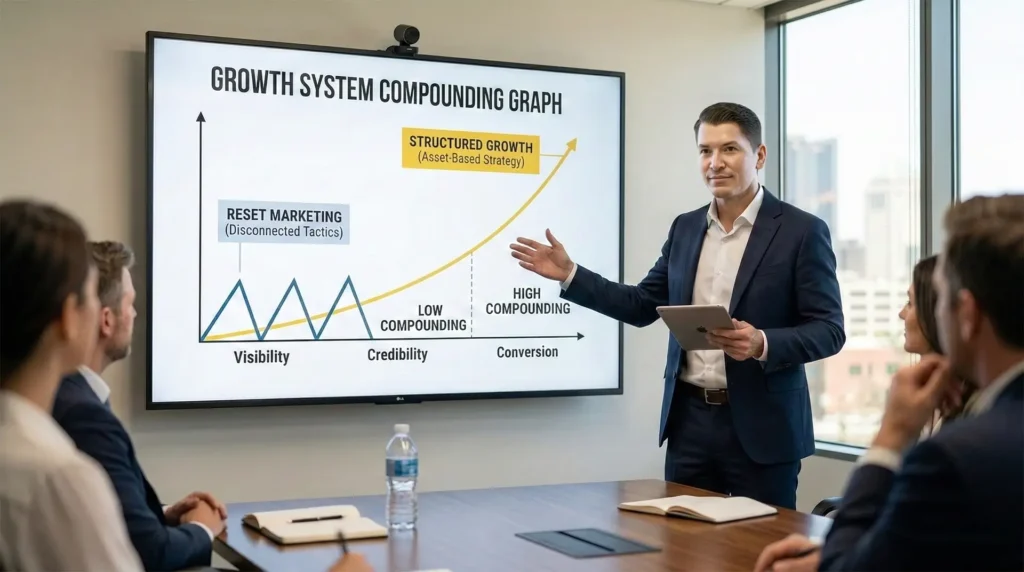
Look at outcomes over time:
One resets after every effort.
The other compounds because it was designed to.
That difference explains why two businesses can invest similar time and money yet see completely different results. One is executing tasks. The other is building an asset.
When marketing lacks structure, it behaves like an expense.
Every time you:
You reset authority. For example, when a company rebuilds its website without preserving internal structure or URL continuity, it can lose accumulated search equity overnight. What took years to build resets instantly.
Search engines lose continuity. AI systems lose contextual clarity. Buyers lose familiarity.
And you lose accumulated value.
Most businesses don’t realize they are paying twice:
A website rebuild without preserving structure wipes out internal linking value.
Stopping ads prematurely discards learning data.
Publishing unconnected blogs creates isolated assets that never mature.
Reset marketing feels active.
But financially, it behaves like churn.
Compounding marketing behaves like equity.
Motion is easy to generate. Momentum is not.
Business owners post on LinkedIn once or twice and expect traction. Others post consistently but without clarity, repeating generic insights that blend into the feed. Some run ads for a few weeks, pause them, then restart later hoping for different results.
The issue is not frequency alone.
It is continuity and alignment.
We frequently see companies publish article after article without a linking strategy, assuming volume will create authority. Without connection, volume only creates fragmentation.
People do not hire businesses because of a single post.
They also do not scroll back years to piece together what you do.
Marketing works when:
Momentum appears only when activity is sustained long enough to learn, adjust, and refine.
Motion stops when effort stops.
Momentum continues because the system carries it forward.
Structure is not abstract. It is operational.
Structured marketing includes:
Structure ensures that:
Without structure, these components exist independently.
With structure, they reinforce each other.
Compounding marketing is not louder marketing.
It is connected marketing.
One of the clearest signs structure is missing is content that exists in isolation. Blogs are published without internal links. Topics change weekly with no plan. Readers are not guided deeper, and search engines are not shown what matters most.
Internal linking is not a technical trick. It is a clarity signal.
It tells readers where to go next.
It tells search engines how ideas relate.
It tells AI systems what themes define your authority.
When content is intentionally structured, each piece increases the value of the others.
The same principle applies to websites.
Businesses often rebuild their site every year because new tools make it easy. But frequent rebuilds reset authority. They erase trust signals and remove accumulated value.
Compounding happens when assets are allowed to mature.
A structured website supported by consistent content improves over time. It gains credibility with humans, search engines, and AI simultaneously.
That is not accidental. It is designed.
If you are unsure whether your marketing is structured or fragmented, ask yourself:
If most of your effort feels temporary, your marketing is likely resetting.
If effort feels cumulative, you are building structure.
Without structure, marketing behaves like an expense. The moment activity stops, results stop.
With structure, marketing behaves like an asset.
Websites become decision engines.
Content builds authority instead of filling space.
Visibility improves because relevance increases.
Trust accumulates because clarity improves.
Older assets are preserved, refined, and connected to new ones. Search engines recognize continuity. AI systems recognize consistency. Buyers recognize credibility.
Over time, structured marketing becomes more efficient.
Each improvement builds on the last instead of replacing it.
Plans list activities.
Strategies build systems.
Without structure, even well-intentioned marketing eventually decays.
With structure, it compounds.
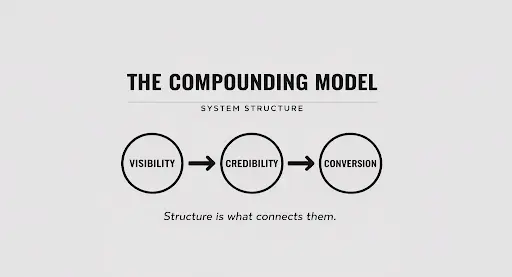
Structured marketing compounds because it follows a sequence:
Most businesses attempt to begin at step three.
They focus on lead volume, conversion rates, or closing speed before the upstream conditions are stable.
But conversion is an outcome, not a starting point.
Visibility creates consistent exposure.
Credibility builds trust through repetition and proof.
Trust makes conversion efficient instead of forced.
Inconsistent visibility prevents credibility from stabilizing.
Weak credibility increases acquisition cost.
Unclear conversion paths cause qualified traffic to leak.
When these elements align, growth becomes measurable and repeatable.
When they are misaligned, marketing performance becomes volatile — regardless of effort.
This is why structure matters more than volume. Structure ensures that visibility builds credibility, and credibility supports conversion; instead of each existing independently.
There is a reason many businesses abandon structured marketing too early.
It does not produce fireworks immediately.
Compounding systems are quieter in the beginning. They prioritize alignment before scale. They refine messaging before increasing traffic. They stabilize conversion paths before expanding channels.
That can feel slow.
But what feels slow initially often becomes powerful later.
Reset marketing creates early spikes and long droughts.
Structured marketing creates steady lift.
Over time, steady lift outperforms spikes; especially when search engines, AI systems, and buyers reward consistency.
Search behavior is evolving. AI systems now summarize and interpret content rather than simply ranking it.
In this environment, structure matters more than volume.
Clear topical authority, preserved historical continuity, and logical content relationships signal credibility across both search and AI platforms.
Fragmented marketing sends mixed signals.
Structured marketing reinforces them.
The businesses that benefit most from AI-driven discovery will not be the loudest. They will be the most coherent.
If your marketing feels like it constantly needs reinvention, you are likely operating without structure.
If your marketing feels like it improves as it matures, you are building an asset.
Compounding is not accidental. It is engineered.
And once engineered, it becomes difficult for competitors to replicate quickly — because structure takes time to build.
If your marketing currently feels busy but disconnected, begin with structure:
Define a clear service hierarchy
Align messaging with buyer intent
Connect related content through intentional internal linking
Preserve and refine existing assets instead of resetting
Stabilize one primary visibility channel before expanding
Engineer conversion paths deliberately
Structure is not louder marketing.
It is connected marketing.
If you are investing time and money into marketing but momentum never sticks, the issue is rarely effort.
It is structural alignment.
Before adding another tactic, evaluate the foundation.
Structured marketing compounds.
Disconnected marketing restarts from zero.
👉 Read next: Why Most Marketing Plans Fail (And What a Real Growth Strategy Looks Like)
👉 Or request a Growth Review to see whether your marketing is compounding, or quietly resetting.