

Most small businesses in Ohio don’t struggle because they lack marketing effort; they struggle because their marketing strategy lacks structure.
They struggle because their marketing lacks structure.
They’re posting, redesigning their websites, trying SEO, experimenting with ads, and testing new platforms. On paper, it looks like consistent progress.
Without a structured approach to visibility and discovery, those efforts rarely connect into a system that compounds.
When results stall, the instinct is to add more; more content, more spend, more tactics. The assumption is that something just hasn’t been tried yet.
In reality, marketing rarely fails because of effort.
It fails because effort is applied without a system designed to carry that effort forward.
With structure, marketing compounds. Each improvement strengthens the next. Visibility reinforces credibility. Credibility supports conversion.
And over time, growth stops feeling chaotic and starts feeling predictable.
This is the Growth Systems Framework.
Marketing activity creates motion.
Structure creates direction.
Without structure, activity produces spikes. Traffic increases briefly. Engagement improves temporarily. Rankings move for a few weeks. Then momentum fades.
This cycle creates frustration:
The missing question is:
Were those efforts connected?
Disconnected activity resets. Connected activity compounds.
If you want a deeper breakdown of why isolated tactics fail to build momentum, read:
Why Marketing Activity Without Structure Never Compounds
That article explains the problem.
This page explains the system.
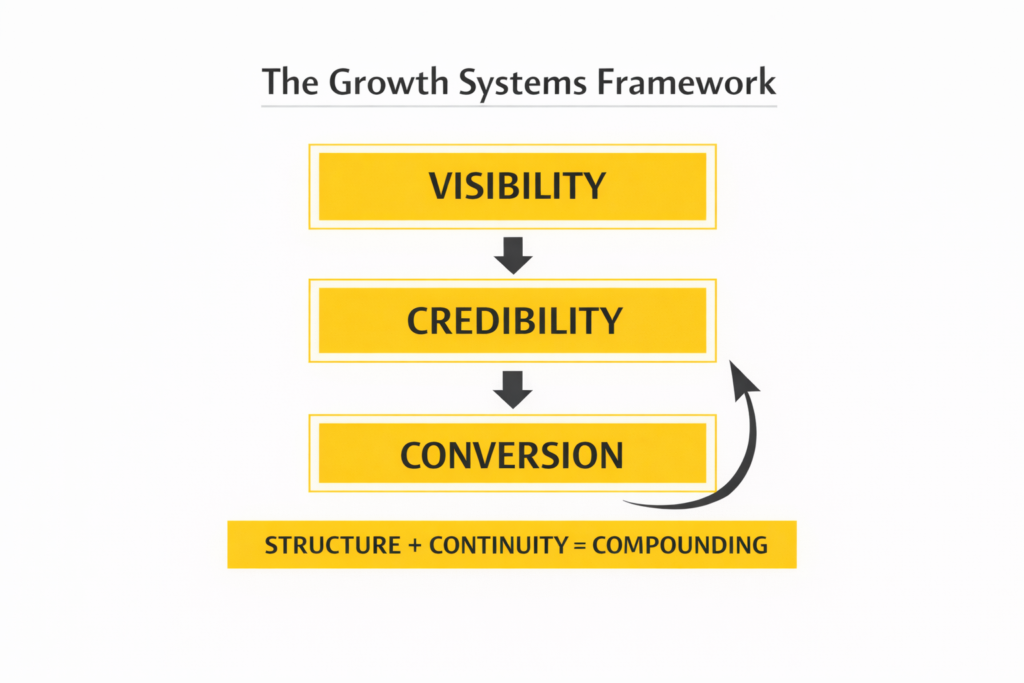
Structured marketing compounds because it follows a sequence: visibility, credibility, and then conversion.
Most businesses try to start at the end. They focus on generating leads or increasing conversions before their visibility is stable or their credibility is established. But conversion is not the beginning of growth; it is the result of upstream alignment.
Visibility means being found where high-intent searches already happen. For Ohio service businesses, that includes organic search, local search results, and structured digital presence. If visibility is inconsistent, growth will always feel volatile.
But visibility alone is not enough.
Credibility answers the next question buyers ask: “Why should I trust you?” Clear positioning, authority signals, case examples, and consistency across platforms reinforce legitimacy. When credibility is weak, increased traffic amplifies doubt. When credibility is strong, increased traffic amplifies confidence.
Only then does conversion become predictable.
Conversion is not persuasion. It is clarity. It happens when messaging aligns with buyer intent, when the path to action is obvious, and when trust has already been established. If visibility builds awareness and credibility builds confidence, conversion becomes a natural progression rather than a forced outcome.
When these three layers reinforce one another, growth begins to stabilize. When they operate independently, marketing feels scattered and reactive.
Compounding happens when the sequence is respected.
Structured growth is not abstract. It rests on layered reinforcement.
For Ohio service businesses, especially in competitive Columbus markets, these six pillars determine whether marketing compounds or resets.
Before visibility scales, trust must already exist.
In competitive Ohio markets, whether Columbus, Dublin, Hilliard, or regional cities, buyers rarely convert on first contact. They validate. They compare. They research.
Credibility is built through consistency:
Clear positioning tells visitors exactly who you serve and what problem you solve. Authority signals, whether case examples, professional associations, or documented results, reinforce legitimacy. Structured messaging ensures that when someone lands on your website, they understand your value within seconds.
If credibility is weak, scaling traffic magnifies confusion.
If credibility is strong, scaling traffic multiplies conversion.
Most businesses try to build trust after they increase visibility.
Structured growth builds trust first.
Many Ohio businesses treat their website like a digital brochure.
But buyers don’t browse brochures, they evaluate decisions.
A structured website does three things clearly:
A structured website clearly explains what you do, clarifies who you help, and guides visitors toward the next logical step.
Hierarchy matters. Service pages must be intentional. Internal linking must reinforce topical authority. Messaging must reflect how real buyers search and think, not how the business internally describes itself.
When structure is weak, traffic leaks.
When structure is aligned, visibility turns into momentum.
This is why constant redesigns often stall growth. They reset authority instead of refining it.
Structured refinement compounds. Redesign cycles reset.
Traffic alone does not produce growth.
Conversion clarity does.
Most conversion problems are structural, not psychological.
Forms are buried. Calls-to-action are vague. Navigation is cluttered. Messaging lacks sequencing.
Structured conversion design asks:
What does someone need to see before they are comfortable taking the next step?
In Ohio service markets especially, decisions often involve:
When the path from discovery to decision is clear, conversion improves without pressure tactics.
Clarity converts better than persuasion.
For service-based businesses in Ohio, local search is often the highest-intent discovery channel available.
When someone searches “IT support near me,” “billing company in Columbus,” or “weight loss clinic in Dublin,” they are not browsing casually. They are evaluating options.
Google Business Profile is not a side asset. It is structural infrastructure.
When properly aligned, it:
Many Ohio businesses either leave their profiles incomplete or treat them as passive listings.
But structured local optimization, correct categories, consistent signals, review strategy, service alignment, can create lift faster than most content campaigns.
As seen in the mental health billing example, local structure can produce what looks like overnight success. In reality, it is algorithmic clarity being recognized.
Local authority compounds when signals are consistent.
It resets when profiles freeze, go dormant, or become inconsistent.
Expansion is where most businesses jump too early.
They add blogs. They test ads. They post on every platform.
But expansion without foundation is expensive.
For Ohio small businesses, especially in competitive markets like Columbus and the surrounding Central Ohio region, disciplined expansion consistently outperforms scattered visibility.
Structured expansion is not about adding more channels. It is about reinforcing what already works.
It begins by building content clusters around real buyer questions and reinforcing service pages with authority-driven content. As those assets strengthen, backlinks earned from relevant sources increase domain credibility. Geographic expansion should only occur after core positioning and visibility have stabilized.
When executed in the correct order, visibility becomes less volatile. Rankings stabilize instead of spiking. Inbound becomes consistent instead of unpredictable.
Expansion should amplify strength. If the foundation is weak, amplification accelerates instability.
This is the least glamorous pillar, and the most important.
Structured growth is not a launch event.
It is disciplined continuity.
Many Ohio businesses cycle through agencies every 12–18 months. Each reset interrupts authority layering. Messaging shifts. Structure changes. Continuity breaks.
Search engines notice. Buyers notice. AI systems notice.
Ongoing execution means:
Sustained growth requires continuity.
For Ohio service businesses, especially in competitive markets like Columbus, continuity becomes a real competitive advantage over time. Businesses that reset every 12 –18 months restart authority. Businesses that maintain structural alignment layer it.
And continuity requires leadership willing to resist the urge to reset every time results fluctuate.
In stable growth systems, month twelve looks stronger than month three, not because tactics changed, but because structure matured.
That is when marketing begins to feel like infrastructure instead of promotion.
An IT company approached us with a common conclusion:
“Marketing just doesn’t work for our industry.”
They weren’t wrong about their results.
But they were wrong about the reason.
They believed:
The website had been built internally by the business owner.
It wasn’t poorly intentioned.
It was structurally incomplete.
Even more challenging, we were not permitted to directly restructure the website.
So we built leverage elsewhere.
We focused on two structural levers:
Their competitors were concentrated in the southern U.S., creating geographic opportunity.
Within 30 days, rankings began to appear.
By 90 days, lift was visible:
Marketing didn’t suddenly “work.”
Structure began reinforcing itself.
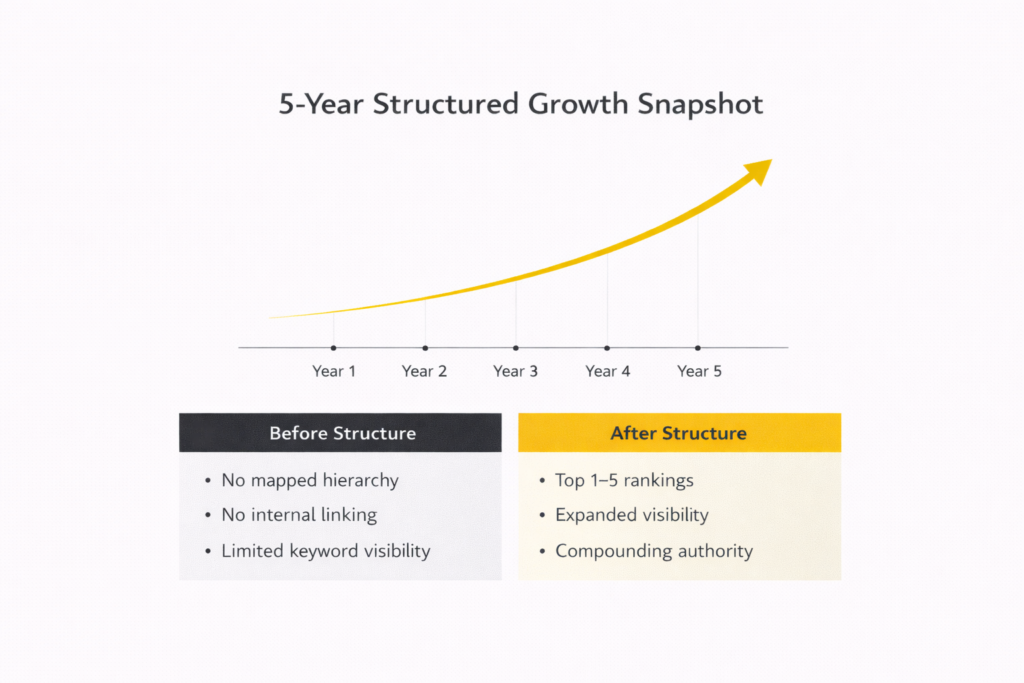
Structure introduced. Rankings followed.
Structure sounds responsible.
But it feels restrictive.
Many business owners resist structural marketing because:
Tactics are attractive because they promise immediate movement.
Structure feels like preparation.
But preparation is what makes scale sustainable.
When businesses skip structural alignment, they often experience short-term bursts followed by stagnation. That reinforces the belief that “marketing doesn’t work.”
In reality, marketing was never given the chance to compound.
Compounding marketing follows a predictable pattern when executed correctly.
This phase often produces early movement simply because friction is removed.
This is where many businesses start seeing measurable improvement.
Traffic begins to convert more predictably.
At this stage, marketing feels less like experimentation and more like infrastructure.
This is when businesses stop asking, “Should we try something new?” and start asking, “How do we scale what’s already working?”
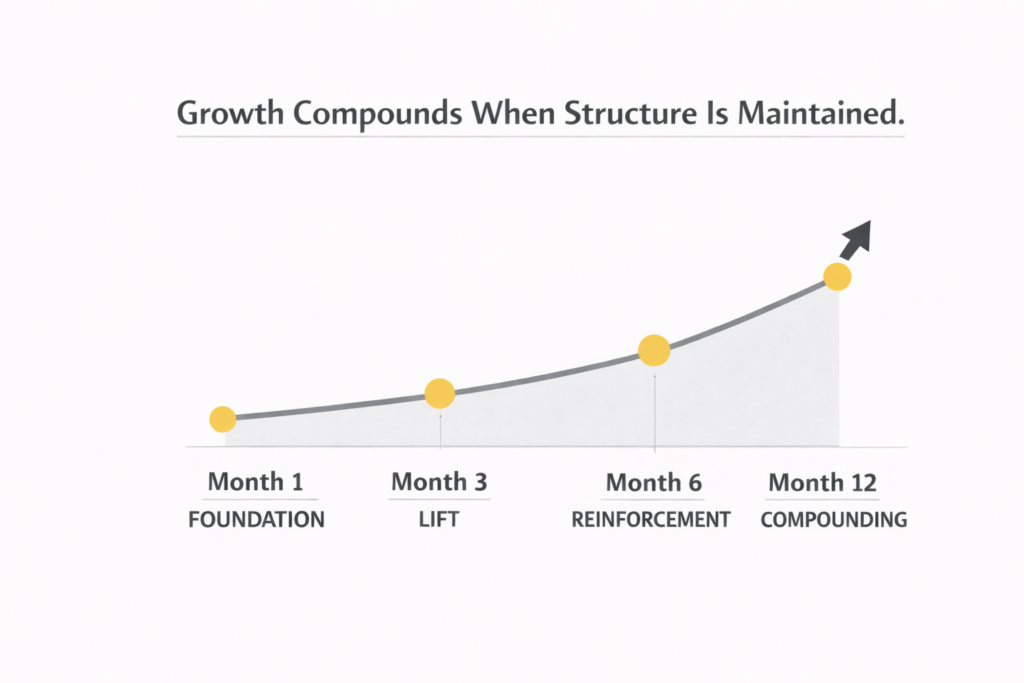
Structured growth rarely spikes. It compounds when maintained.
Most businesses did not try structured SEO.
They tried isolated tactics.
True SEO alignment requires:
Without those, SEO feels ineffective.
Competition amplifies the need for structure.
In competitive industries, random tactics disappear quickly.
Structured authority builds durability.
As seen in the IT example above, even competing against Microsoft-related keywords becomes possible when structure reinforces authority.
Small markets amplify structural clarity.
In Amy’s case, the town was not the limitation.
The frozen Google Business Profile and lack of alignment were.
When structure was introduced, visibility improved rapidly.
Reset marketing consumes more time than structured marketing.
Constant reinvention, redesign, and experimentation create more workload than disciplined execution.
Structure reduces long-term effort.
Structured marketing creates something competitors cannot easily replicate: continuity.
Anyone can launch a campaign.
Few businesses can maintain alignment for 12 months.
Search engines reward continuity.
AI systems reward thematic consistency.
Buyers reward clarity.
Structure creates competitive insulation.
It becomes increasingly difficult for competitors to outrank, out-message, or out-position a business that has layered authority over time.
A mental health billing specialist believed her small town had limited growth.
It didn’t.
Her Google Business Profile was frozen.
Her website had no SEO architecture.
We guided her through unfreezing the profile and rebuilt her site with structured hierarchy.
We did not run ads.
We did not chase vanity metrics.
Within 60 days:
When ongoing work paused, momentum slowed, proving sustained growth requires continuity.
Her market was never too small.
Her structure was incomplete.
Search behavior is evolving.
AI systems interpret author As Google explains in its overview of how Search works, ranking systems are designed to evaluate helpful content, relevance, and signals of authority across the web; not isolated tactics or short-term activity, summarize content, and evaluate thematic depth.
Fragmented marketing sends mixed signals.
Structured marketing sends reinforced signals.
AI systems reward clear topical authority, consistent messaging, logical content relationships, and verified business signals.
Businesses that build coherence will outperform those chasing tactics.
Structured growth does not begin with amplification. It begins with alignment.
Phase one focuses on structural clarity; refining positioning, strengthening core service pages, and ensuring internal consistency across the site.
Phase two reinforces authority through disciplined content expansion, topical alignment, and signal strengthening.
Phase three amplifies visibility strategically, but only after structural integrity and authority signals are stable.
The sequence matters. Amplification without alignment increases volatility. Alignment before amplification increases predictability.
There is no single tactic that creates sustainable growth.
There is no shortcut around structure.
What creates momentum is disciplined execution in the right order.
That is the difference between marketing that resets and marketing that compounds.
Growth does not start with a tactic.
It starts with structure.
If your marketing feels scattered, stalled, or harder than it should be, the next step is not another platform.
It is a diagnostic.
Most businesses treat marketing as promotion.
Promotion is episodic.
You launch something, announce something, run a campaign, post an update.
Promotion creates bursts of attention.
Infrastructure creates sustained visibility.
When marketing is treated as infrastructure, it is designed to preserve authority, strengthen internal connections, reinforce positioning, reduce volatility, and increase predictability.
Infrastructure thinking changes how decisions are made.
Instead of asking:
“What should we try next?”
You ask:
“What strengthens the system?”
That shift alone changes outcomes.
Reactive marketing responds to competitor activity, trend cycles, platform changes, and short-term pressure. Intentional marketing responds to strategic positioning, long-term authority building, signal reinforcement, and system refinement.
Reactive marketing resets constantly.
Infrastructure marketing layers.
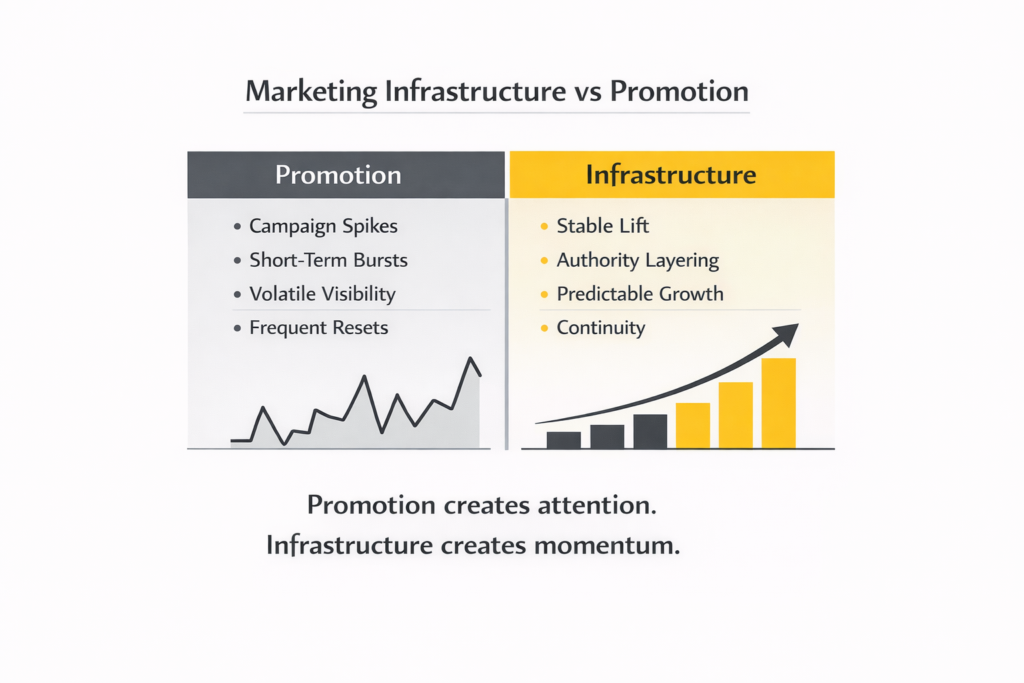
Promotion creates attention, but infrastructure creates momentum.
Many businesses avoid structured marketing because it feels like a long-term commitment. But the greater risk is instability.
When marketing depends on constant ad spend, daily social engagement, short-term spikes, or unpredictable algorithm shifts, revenue becomes volatile. Growth feels tied to activity rather than alignment.
Infrastructure changes that dynamic.
When marketing is built structurally, organic rankings stabilize. Local visibility stabilizes and strengthens over time. Authority strengthens. Conversion rates improve not because pressure increases, but because clarity improves.
This does not eliminate work. It makes effort more predictable.
When marketing functions as infrastructure rather than promotion, the business behaves differently.
Redesigns become rare because structure is refined instead of replaced. Messaging stabilizes because positioning is clarified before amplification. Content builds on itself rather than competing with itself. Visibility expands naturally as authority layers accumulate.
Competitors who operate in reset cycles struggle to displace businesses that maintain structural continuity.
Momentum becomes easier to sustain.
That is how structural momentum builds.
It is not dramatic. It is durable.
Most competitors launch initiatives in bursts. They experiment, pause, redesign, change agencies, and start over. Each reset interrupts authority and weakens accumulated signal density.
Businesses that resist the reset cycle gain advantage quietly.
Authority deepens. Visibility stabilizes. Signal density increases.
Compounding is rarely loud at the beginning. But over time, it becomes difficult to disrupt.
The businesses that grow sustainably share a common trait: they stop chasing movement and start building systems.
They understand that month one is foundation, month three is lift, month six is reinforcement, and month twelve is compounding.
Strategic patience becomes easier when the system is visible. When structure is mapped clearly, growth feels measurable instead of mysterious.
If you’re an Ohio business owner and your marketing feels scattered, stalled, or harder than it should be, the solution isn’t another tactic.
It’s structure.
Before you invest in another campaign, redesign, or ad spend, understand whether your foundation is capable of compounding.
At Columbus Marketing Experts, we build structured growth systems designed to compound over time.
Start with a Growth Review and see what your current marketing system is actually built to support. Growth becomes predictable when structure leads.