
For the last two decades, the blueprint for a successful local business website was simple: make it look professional, list your services clearly, ensure your phone number is easy to find, and optimize it for a human scrolling on a desktop or phone.
As of June 2026, that traditional blueprint is officially dead. Agentic browsing SEO is already a ranking factor on Google Search Console.
Yeah, I said it. How do I know? My marketing competitors have been around for decades. They outrank me just because they have been around longer. However, our current website is about 6 months old. It outranks all of the websites in the area that have been around for 5 years. We are closing in on our legacy competitors and at this rate, we will pass the local big one within the year. They haven’t even fixed their old SEO, let alone started addressing agentic browsing. Why? Well, they say that they offer those services but in reality, they use a lot of templates. Templates are easy for marketing companies to pump out, even on Webflow and WordPress.
So while they say that they are awesome at it, in reality, they’re awesome at doing mass numbers of templated websites, including their own. Meanwhile, we use more code to make our client websites. It allows the websites to look good and perform at elite levels. Google Search and Agentic browsers reward that kind of performance by showing it to more people and more AI agents when they search for those services or products.
We have crossed a major digital threshold. The internet is rapidly shifting from a directory of hyperlinks into an automated ecosystem run by Autonomous AI Search Agents. Today, a massive and growing percentage of your traffic isn’t a human typing a keyword into a search bar; it is an AI model crawling, extracting, evaluating, and making direct commercial recommendations to a consumer before they ever click on a standard web page.
If your website’s background code is bogged down by messy templates, unoptimized architectures, or invisible structural errors, you aren’t just losing human visitors. Now, you are completely invisible to the AI crawlers making the decisions.
How do you know if your backend code is bogged down? If you didn’t purposefully write code in the backend of your website within the last two months, then it is obsolete. And by obsolete, I mean agents will skip over your site because the new rule just rolled out. And Google Search Console just added the feature to check on it, as of June 2026.
To win the local market today, your digital infrastructure has to speak two languages perfectly: it must deliver flawless, jargon-free strategy to human buyers, and it must provide hyper-clean, lightning-fast technical architecture to the automated agents mapping out the web.
When most local business owners hear the words “content marketing,” they picture the traditional, 2018-era playbook: publishing generic, 500-word blog posts stuffed with local keywords, writing basic “how-to” articles, or blasting out low-effort social media updates.
If you look at standard content marketing for agencies across Central Ohio, this is exactly what you see. Local firms rely on shallow, top-of-funnel information designed to game old-school search engine results pages (SERPs). They push out basic definitions of industry terms, hoping a human clicks their link, scrolls for three seconds, and fills out a form.
But in an ecosystem dictated by AI search models, that style of agency content marketing is worse than useless, it is actively damaging to your brand’s authority.
Google’s algorithmic preference has fundamentally shifted toward semantic depth and structured entity mapping. When an AI crawler or an autonomous agent reads your site, it isn’t scanning for a simple keyword density percentage. It is analyzing your site’s comprehensive knowledge graph to see if your domain possesses genuine, contextually deep expertise. Shallow articles are instantly flagged as low-value noise and bypassed entirely.
Now don’t take what I just said and twist it. I’m not saying that more is better. Absolutely, do not go use an AI blogging system to pump out a 10,000 word article. Nobody has time for that. Not humans, not search engines, and not AI. Instead, I’m saying write your articles like a research paper but explain it from your point of view, not from the generic POV that a blogging system will pump out.
To capture high-intent leads today, your business content must shift from top-of-funnel fluff to dense, structured data hubs.
This is where the platform you build on becomes a massive strategic lever. Custom, cleanly optimized WordPress frameworks allow businesses to construct highly organized, technically pristine data silos. Unlike rigid, proprietary drag-and-drop page builders that spit out messy, heavily nested div wrappers, a clean WordPress backend lets you structure your data so human prospects get massive value, while AI models can effortlessly extract, synthesize, and source your business as a primary local market authority.
So yeah, you need to write for search engines and AI. If they decide that your content is good enough, they’ll show it to humans. In other words, as of June 2026, you have three distinct audiences that you need to write for if you want to maximize your reach. Start that process now and you’ll be ahead of the game for a while. Your competitors will either catch on or just die off.
How? They’ll be chasing old school keywords on search engines and they’ll pump more money and effort into that when they see you falling behind on older ranking methods. Meanwhile, you’re actually pulling ahead by following the new standards.
So ask yourself, how many quarters can your competitors operate at before they either conduct mass layoffs or just fold. This kind of event happens in business every few years. But nothing this big happened to search engines for the last 20 years.
For years, enterprise marketing budgets have been heavily tied to legacy digital ad frameworks. Multi-million dollar campaigns rely on complex paid ads management software and traditional programmatic advertising display networks to hyper-target users based on historical tracking cookies and behavioral data slop.
If you look at how standard firms handle client acquisition, they dump massive capital into traditional programmatic display tactics, hoping to buy their way to top-of-mind awareness.
But as of May 2026, Google officially updated its Core ranking framework and fundamentally shifted how its systems evaluate website usability.
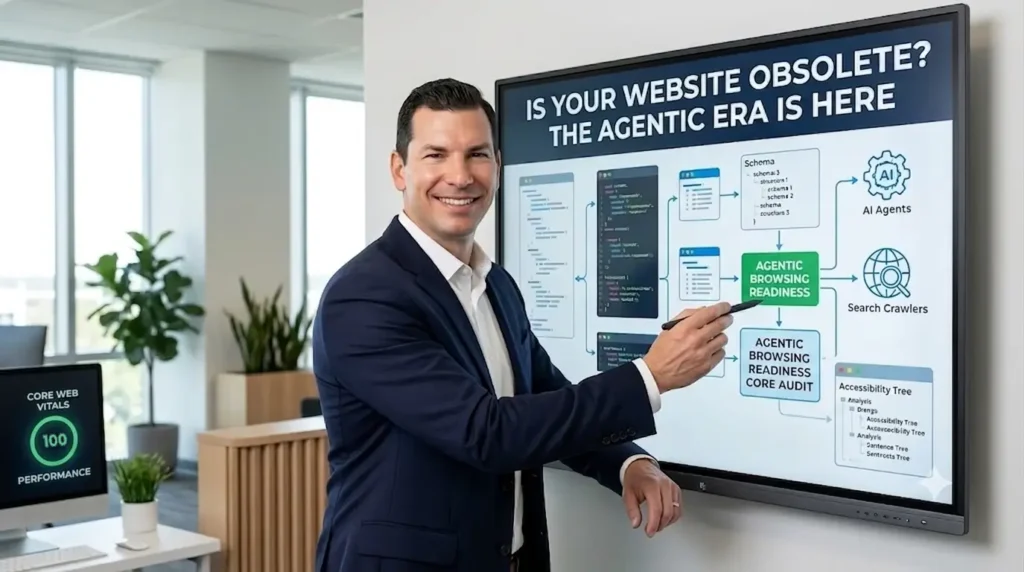
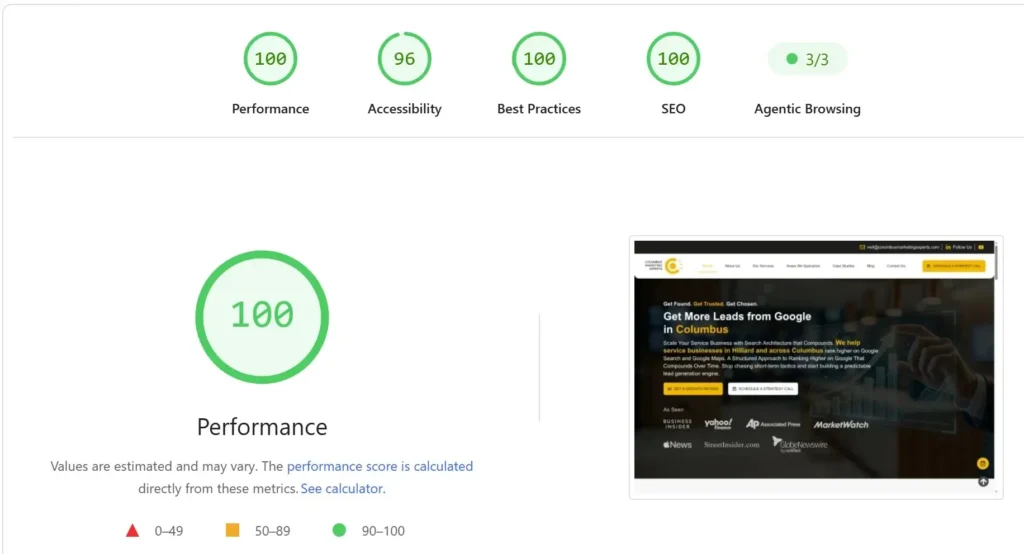
With the rollout of Lighthouse 13.3, Google moved its brand-new “Agentic Browsing” audit straight into its default core configuration. This tool doesn’t measure how pretty your site looks to a human visitor; it measures whether an autonomous AI agent can successfully navigate your code, parse your fields, and execute tasks on a user’s behalf.
Again, “pretty” is not a ranking factor. And there’s a strong chance that the flashy feature is unreadable to AI.
You don’t have to dump it all. Just stop falling for the kitty riding on a unicorn shooting lasers features that some branding guru tries to push on you.
[Legacy Traffic] –> Human User –> Clicks Link –> Standard Web Page
[2026 Traffic] –> AI Agent –> Parses Site –> Delivers Inline Synthesis / Automated Booking
If your agency isn’t building for this shift, your paid ad budgets are essentially lighting money on fire. Why? Because when a user instructs their AI assistant to research and find the best local business, that agent executes what Google calls a query fan-out. Which means, parallel-processing dozens of sites in seconds. If your site trips any of the new Agentic Browsing tripwires, the agent simply drops you from the evaluation loop entirely.
According to the new Lighthouse 13.3 documentation, if you want your business to be eligible for automated discovery and inline citation, your technical framework must pass three newly operationalized standards:
When your competitors are busy managing outdated ad campaigns, they are fundamentally ignoring the underlying infrastructure. By building a clean, modern, and agent-ready asset on WordPress, you don’t have to keep bidding up ad costs. You simply position your business as the most accessible data source in the local ecosystem.
I know, you’re thinking this could be an over reaction. But the truth is Cloudflare (one of the most authoritative entities on internet traffic) said that as of June 2026, bot or automated traffic has now surpassed human traffic on the internet. That means, if you haven’t made the updates yet, you’re already losing ground and fast.
Many branding firms will tell you that learning how to build a brand image comes down to visual aesthetics, like picking the right color palettes, designing a modern logo, or paying for vanity awards. They treat your digital footprint like an art project.
But let’s face it: there’s a reason we’ve heard the term “starving artist.” Yes, keeping the message on brand is important. But that message is only important once it is actually in front of human eyes and human minds to follow with the least amount of fatigue. Until then, we are just talking about cosmetics. The true gatekeepers are the search engines and AI models.
The artists usually skip that piece. They rely on rigid templates, even on platforms like Webflow, just so they can make a site look cool. However, we’ve looked deep into those websites and can see that although they boast about using Webflow, they are just relying on pre-made templates because it is easier for them. It’s also exactly why our custom WordPress websites consistently outperform their Webflow setups. We could use templates, but we prefer custom code because it just works better, every… single… time.
If you want to know how to develop a brand image that actually commands market share in Central Ohio, the answer isn’t cosmetic. In a machine-majority internet, your brand identity is directly tied to your site’s programmatic integrity, technical execution, and concrete conversion architecture. Meaning, the code must align. If it doesn’t, all the fancy colors, animations, and toggles won’t matter because nobody will see them.
Here’s a fun fact: you can tell a lot about a marketing company by just going through their website. If their case studies all share the exact same layouts, like a fake laptop with a static screenshot dropped inside it and broken links, that tells you exactly what you need to know. They use templates. If their website comes up when you search for something like “website building,” but you read their actual page and they focus almost entirely on social media, that tells you their own branding is already broken.
The point is simple: take a step back when you read an agency’s website. Why did you go to it? When you landed on it from a search, did it try to razzle-dazzle you and shift the conversation to something else, or is it fiercely focused on answering your question?
We make sure that when someone searches for your service or product, they get exactly what they are looking for quickly. Now, the major difference is that we do that same exact thing for search engines and for AI.
A flashy website that causes Cumulative Layout Shift (CLS) because it was poorly slapped together on a heavy drag-and-drop builder actively degrades your reputation. When layout elements jump around as a page loads, human visitors get frustrated and leave. Even worse, Google’s new Lighthouse 13.3 Agentic Browsing framework flags those layout shifts as a critical failure. An AI agent attempting to click a button or extract data at millisecond speeds will miss the target entirely if the layout shifts mid-render. From the machine’s perspective, your business is literally broken.
This technical friction is where most local campaigns fail. When legacy agencies manage seo local services, they focus entirely on surface-level keyword stuffing while completely ignoring the backend architecture. They leave local service companies buried on pages 2, 3, and 4 of search engines, precisely where our local competitor analysis shows most agencies are currently stuck.
True local dominance requires a framework where clean code and conversion strategy work in absolute unison.
For Central Ohio businesses looking to step out of legacy traps and scale their digital footprint, our core web design company columbus ohio solutions are built exclusively on high-performance WordPress frameworks engineered to satisfy human decision-makers, legacy search algorithms, and autonomous AI crawlers simultaneously.
By shifting your architecture to clean, enterprise-grade development, you ensure that every asset, from your call-to-action buttons to your complex data structures, is fully indexed, stable, and ready to capture human and machine intent alike.
The shift toward an internet dominated by automated traffic isn’t a distant projection; it is the active, operating reality of June 2026. The companies that continue to treat their websites like static, visual brochures will find themselves entirely erased from the automated discovery loops that modern consumers rely on daily.
You don’t need a website wrapped in complex, unreadable design gimmicks. You need clean, enterprise-grade architecture that delivers pristine strategy to human buyers and flawless data structures to AI search agents.
The baseline standards have changed. Your competitors will continue to dump capital into outdated, brute-force keyword strategies, bleeding cash until their operating margins force a collapse. Meanwhile, you can quietly pull ahead by aligning with the modern framework the web actually runs on.
Ready to find out if your technical infrastructure is obsolete? Click here to secure an Advanced WordPress & Agentic Architecture Audit with our team today, and lock down your digital footprint before the next algorithmic shift leaves your business behind.