

High traffic volume is a vanity metric; conversion density is the only number that impacts your bottom line. In the Columbus market, where the cost-per-click (CPC) is rising across industries like Legal and Home Services, “generic traffic” is actually a liability. If you’re paying for clicks but seeing a 90% bounce rate, your messaging is misaligned with the User Intent that brought them there. That is literally a mistake that is costing you money.
To stop the leak, you must move beyond basic CTAs like “Get a Quote.” In an AI-driven search world, users expect Specific Value Exchange. Instead of a generic button, use action-oriented triggers that promise immediate utility, like a “Dublin, Ohio Property Value Map” or a “3-Minute Local SEO Audit.” Think about it, if you have a realtor website and you have a property value map that captures leads, there is a mutual exchange of benefits. You see who exactly is interested in the local area and the prospect actually gets data that they can use as soon as they fill out the form.
Furthermore, “Fast and Mobile-Friendly” is no longer a perk; it is the baseline. If your site takes more than 2 seconds to render on a 5G connection in the Short North, Google’s AI models will categorize your UX as “Low Effort,” effectively de-prioritizing your conversion elements. And yes, if you have a website with videos and a lot of photos, you’re probably blowing past those stats; even if a marketing company is “managing” your website.
Finally, shift your focus from “Keywords” to “High-Intent Entities.” Stop chasing broad terms like “Marketing” and start dominating “Columbus B2B Lead Generation.” By layering in localized trust signals, like neighborhood-specific reviews and Ohio-based security certifications, you transform a skeptical visitor into a high-intent lead.
If your website is not converting, but you are not tracking what visitors are doing, you are guessing. This is the same issue behind marketing activity without structure never compounds.
In the Columbus market, “generic” is expensive. If your website relies on hollow phrases like “we provide solutions” or “industry-leading results,” you are essentially paying a vague language tax. Because most of what you read today is AI-generated noise, local business owners have developed a natural filter for “corporate speak.” When a prospect from the Short North or Dublin lands on your page, they aren’t looking for a “solution,” they are looking for a bridge out of their specific frustration.
To fix the engagement gap, you must pivot from Features to Emotional Outcomes. Instead of a generic service list, try a high-relatability hook: “We help overwhelmed Columbus small business owners automate their lead flow so they can actually leave the office by 5 PM.” This doesn’t just describe a service; it describes a transformed life. Everyone wants to reclaimed their time. By solving that “universal” issue with a local focus, you pull clients in rather than pushing a sales pitch.
Furthermore, your Unique Value Proposition (UVP) must be localized and undeniable. If you offer a 24-hour turnaround in Franklin County that your national competitors can’t match, that should be your H1 headline, not buried in your footer.
Finally, stop guessing and start A/B Testing. In 2026, we use data-driven adjustments to pit “formal” messaging against “direct” messaging. By measuring which narrative actually reduces bounce rates for your specific Ohio audience, you move from “throwing spaghetti at the wall” to a precision-engineered conversion machine.
Speaking of generics, do yourself a real favor. Open up another tab in your browser and search for “Columbus Marketing Experts.” You’ll see us, the legit experts in SEO, Search, and AI; right alongside a list of competitors who pay to be on the page with us. They pay to siphon off our name. It is legal, so we live with it; but for you, the lesson is clear: if an agency has to pay just to show up next to our name, how are they ever going to help you earn the top spot on your own?
Use high-contrast colors and bold typography to make your primary action pop. This isn’t just about aesthetics; it’s about Visual Hierarchy. Your CTA should be the most obvious element on the page, acting as a visual “anchor” for the user’s eyes as they scroll.
Stop placing CTAs only at the bottom of the page. You must insert them at Critical Moments of Intent. If a visitor just read about how you saved a Lewis Center client 20% on their CPC, that is the exact moment to offer a “Local Lead Audit.”
Generic buttons yield generic results. Experiment with Action-Oriented Utility. Instead of “Learn More,” try “Download the 2026 Columbus SEO Roadmap” or “Claim My Free Short North Competitive Audit.” Small tweaks in wording that promise a specific outcome can lead to a 200% increase in conversion density.
Social proof is the ultimate “conversion lubricant.” By placing a snippet of a testimonial or a “5-Star” badge directly next to your CTA, you provide the immediate reassurance needed to click. It tells the visitor: “Others in Ohio have done this, and it worked.” Use real reviews that are imported from Google Reviews, Clutch, G2, Yelp or whatever you use. Do not just add a quotation without it linking to somewhere that isn’t verifiable. Fake reviews will crush any chances of getting a client to click any further on your website.
Be careful not to overwhelm your audience. In 2026, less is more. Limit the number of competing actions on a single page. If you want them to call you, don’t also ask them to sign up for a newsletter and follow you on X. Focus their attention on the Primary Action that moves the needle for your business. You can do all of those other calls to action later on in your relationship. We’ve got news for you, if you add a bunch of calls to action, you look less legitimate to humans and is slows down your website which will get penalized by AI and search engines.
In 2026, your website’s design is your “Digital Storefront,” but its functionality is your “Sales Team.” If your site feels clunky, unintuitive, or slow, you aren’t just losing a visitor—you are signaling to search engines that your business is a high-friction destination. AI models now measure User Effort; if it takes too many clicks or too much time to find an answer, you will be de-prioritized in favor of a more efficient competitor.
Website loading speed is no longer a “minor detail.” In a world of 5G and instant gratification, even a two-second delay in the Short North can lead to a 50% drop-off in retention. We optimize for Core Web Vitals because we know that speed is a trust signal. If you can’t manage your own site’s performance, a prospect will assume you can’t manage their project either.
If you’re running on a platform like Squarespace or Wix or using an AI-generated template bloated with unoptimized videos and high-res photos, there is an extremely high chance you’re simply too slow. We see marketing companies and their clients across the Columbus area struggling with this exact issue every day. It’s a common trap: you build a website designed to “wow” a visitor with heavy visuals, but those same visuals ensure the potential visitor never sees them.
With mobile browsing dominating over 70% of local search traffic in Central Ohio, a “mobile-friendly” site is the bare minimum. Your site must be Mobile-Responsive by Design, ensuring that buttons are “thumb-friendly” and text is legible without zooming. If a user on a smartphone in Dublin can’t find your “Call Now” button in under three seconds, they’re gone.
Stop guessing what your customers want. We use Usability Testing and Heatmaps to pinpoint exactly where potential leads get stuck. By identifying “friction points” in your navigation and layout, we make informed adjustments that streamline the path to conversion. High-performance UX is about removing the obstacles between a user’s question and your solution.
Clarity is the ultimate conversion tool. We use Hierarchical Headings (H1s, H2s, H3s) to guide visitors and AI crawlers through your content. This doesn’t just improve readability; it creates a “Logical Flow” that makes your expertise effortless to digest. When a user can find exactly what they need without searching, they don’t just stay on the site; they convert.
Getting traffic to your website is only half the battle. If you’re attracting the wrong audience, even a flood of visitors won’t lead to conversions. To tackle this challenge, start by refining your SEO strategy. Shift focus to long-tail keywords that resonate with the specific needs and pain points of your ideal customers. For example, instead of competing for general terms like “digital marketing,” target keywords like “affordable digital marketing for small businesses in Chicago.”
Do not, just scrape your competitor’s website and copy their process. It will not work for you. AI and Search engines will see duplicated information and your copy and paste effort will be for nothing. We bring this up, because there are a lot of ads out there, that claim to scrape, copy and give you the edge. However, when those ads say “nobody’s talking about this” its because it doesn’t work alone. It didn’t work 5 years ago and it definitely doesn’t work today. You want a similar audience but you need to be unique and not in an AI generated article way where you just deleted dashes, changed a few words and called it good.
Trust is the cornerstone of any high-converting website. In 2026, visitors aren’t just skeptical, they are “AI-aware.” They know that photos can be faked and reviews can be bought. If a prospect doesn’t feel an immediate sense of Verified Credibility within the first few seconds of landing on your site, they will bounce. At Columbus Marketing Experts, we don’t just “show” results; we prove them through a framework of transparency and local social proof.
Generic testimonials like “Great service!” no longer move the needle. To build real authority, you must showcase Verified Case Studies. These are deep-dive narratives that prove your expertise through real-world problem-solving. When you prominently display how you solved a specific growth issue for a business in Hilliard or the Short North, you aren’t just asking for trust, you are earning it through Experience.
In 2026, an SSL certificate is a non-negotiable baseline, but modern trust goes deeper. However, we still somehow come across websites without the SSL certificate. And yes, that’s likely a website that was slapped together. We prioritize Technical Trust Signals, including secure transaction badges and “Verified Partner” status from reputable organizations (like Google or Microsoft). These visual anchors act as a “Security Handshake” with your visitor, reassuring them that their data and their decision-making process are in safe hands.
The “Contact us for a quote” era is fading. Modern users demand transparency in pricing, policies, and procedures. By clearly outlining your “Way of Working” and being upfront about costs, you eliminate the “Fear of the Unknown” that often halts a conversion. Transparency isn’t just about honesty; it’s about reducing Conversion Friction.
Now you don’t have to give pricing for everything. For example, we don’t build templated websites with templated SEO. So at Columbus Marketing Experts, we do have to meet with the client and build a plan from scratch. On the other hand, we try to give some insight into what that can cost so that we don’t attract the tire kickers. After all, when we look at our top 10 competitors, most of them use templates for their websites and their clients. That’s totally fine, and there is a market for it. And believe it or not, we get a lot of clients that outgrow those templates once they realize the glass ceiling.
The key point is that you need to be transparent so you attract the right client at the right time.
The fastest way to kill trust is a “Ghost Town” website. Responsive customer service, whether through live chat or lightning-fast lead responses, shows that there are real humans behind the brand. In an automated world, being accessible and responsive is a competitive advantage that solidifies your reliability and encourages prospects to take the final step.
We went through 30 IT websites this month and found five of them that were so broken down, that we weren’t even sure if they were in business anymore.
Clearly defined services can significantly boost your website’s conversions. First, list your services in a straightforward manner, avoiding jargon. For example, instead of saying “we offer digital solutions,” specify, “we provide website design, SEO services, and social media management, tailored to enhance your online presence.” Each service should come with clear explanations of its benefits, making it easy for visitors to understand what they gain by choosing you.
Creating dedicated service pages is another powerful strategy. Each page should detail one specific offering and include visuals, like images or infographics, to enhance understanding. Use real-life examples or case studies to showcase how your services have helped previous clients. This not only makes your offerings clearer but also builds trust.
Utilizing a Frequently Asked Questions (FAQ) section can address common concerns and inquiries about your services. This helps potential customers feel informed and confident in their decisions. If they can easily find answers to their questions, they are more likely to convert.
Make sure to provide clear contact methods for inquiries about your services. Highlighting contact forms, phone numbers, or live chat options ensures that interested visitors can easily reach out for more information. Don’t forget to emphasize any special offers or promotions for specific services. Creating a sense of urgency through limited-time discounts can motivate potential customers to take action immediately.
To truly connect with your audience, your website and Google Business Profile need to sing the same tune. Regularly updating both platforms ensures that your messaging is consistent, avoiding any confusion that could turn potential customers away. Use the same key phrases and language across both platforms to reinforce your brand identity. For example, if your website highlights your expertise in “eco-friendly landscaping solutions,” make sure your Google Business Profile echoes this language.
Consistency extends to specifics like contact information and hours of operation. If your website states you’re open until 7 PM but your Google Business Profile lists 6 PM, you risk losing a customer who arrives after the earlier time. Similarly, ensure that service descriptions align perfectly on both platforms.
Engaging with reviews on your Google Business Profile is another crucial step. Responding promptly not only showcases your dedication to customer service but also builds relationships that can convert into sales. It’s about creating a narrative that resonates with your audience.
Additionally, dive into the insights from your Google Business Profile. Analyze how visitors interact with your listings and adjust your website accordingly. If you notice that certain services are drawing more interest, prominently feature them on your site. This alignment creates a seamless experience for potential customers, guiding them from curiosity to conversion.
Navigating your website should feel like a stroll in the park, but if it’s confusing, visitors will bounce faster than you can say “click away.” Keeping your main navigation simple is key, limit it to no more than seven categories to prevent overwhelming users. Each label should be descriptive and clear, so when someone clicks on “Services,” they know they’ll find exactly what you offer, not a maze of subcategories. Testing your navigation with real users is invaluable; their feedback can reveal hidden frustrations that you might not see. Implementing breadcrumb navigation is a great way to help users understand where they are on your site and allow them to easily backtrack if they get lost. And let’s not forget about broken links, nothing screams frustration like a dead end. Regularly check that all your links are functioning properly, as broken links can send your bounce rates skyrocketing and lead to lost opportunities.
Your value proposition is the heart of your website. If visitors can’t quickly grasp what makes your offerings special, they will likely leave in search of clearer options. To avoid this, define your unique selling points clearly, allowing visitors to recognize the benefits of your services at a glance. Use straightforward language to explain how you solve specific problems for your target audience. Instead of vague statements, be direct and specific about what differentiates you from competitors, like saying, “We provide tailored marketing strategies for small businesses in Boston, helping them increase online sales by 30% within three months.”
Incorporating relatable examples or case studies can further illustrate your value proposition in action. For instance, share a story about a local client who transformed their online presence through your services, detailing the specific outcomes they achieved.
Visual elements such as icons or graphics can reinforce your key points and make your value proposition more engaging. Position this information prominently on your homepage and landing pages to ensure maximum visibility. Don’t hesitate to test various formulations of your value proposition to see which resonates best with your audience.
Utilizing customer feedback is crucial, as it helps you refine your messaging based on what appeals to them most. Keep in mind that your value proposition should evolve as your business grows or as you gain new insights about your audience. The clearer and more compelling your value proposition, the more likely you are to convert traffic into action.
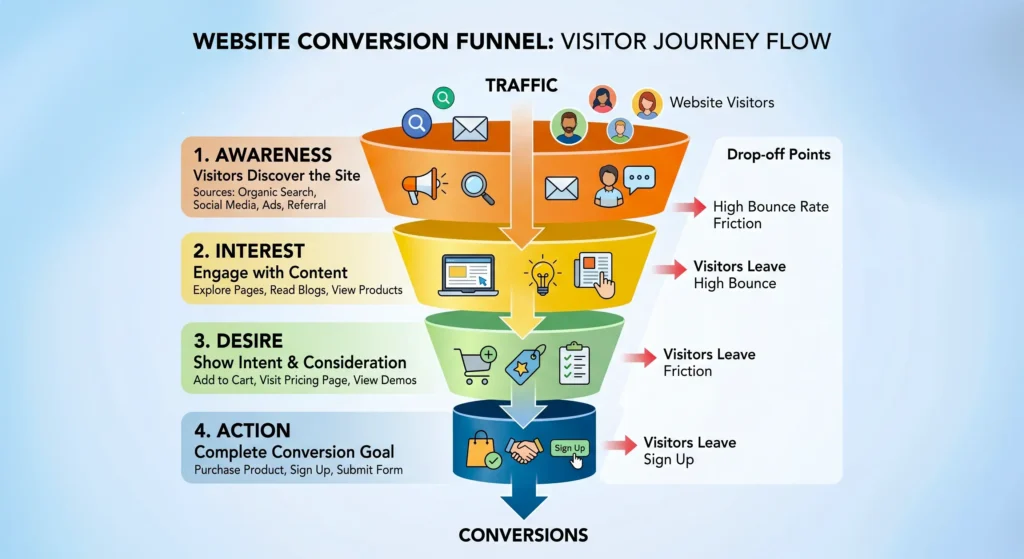
Friction in your conversion processes can seriously hurt your results. Start by analyzing your conversion funnel to pinpoint where users drop off. Are your forms too long? Reduce the number of fields to only what’s absolutely necessary. Users often abandon lengthy forms, so streamline the experience. Incorporate auto-fill options to save time and effort for visitors. If you’re using multi-step forms, add progress indicators to show users how close they are to completion, keeping them engaged.
Website speed is crucial too; if your site loads slowly, frustrated users will leave before they even see what you offer. Ensure your site is optimized for mobile navigation, as many users access websites via smartphones. Test different layouts and designs for your forms to find the most user-friendly options. Clear instructions or tooltips within forms can assist users, helping them complete them without confusion.
Finally, leverage A/B testing to compare various conversion strategies and make data-driven decisions. Don’t forget about exit-intent pop-ups that offer incentives or assistance to users who are about to leave without converting. Reducing friction in these processes can significantly boost your conversion rates.
If your website is not converting, but you are not tracking what visitors are doing, you are guessing.
You do not need more tools. You need clarity on a few key points:
That alone will show you where conversion is breaking.
If people are leaving quickly, the issue is usually messaging or structure.
If they are clicking but not contacting you, the issue is usually clarity or next steps.
If they never reach your service pages, the issue is navigation or alignment with your Google Business Profile.
Tools like analytics and heatmaps can help, but they are only useful if you are looking for specific breakdowns in the path to conversion.
The goal is not to collect data.
The goal is to identify where structure, visibility, and messaging stop working together.
When your website, Google Business Profile, and content are aligned, conversion improves without needing more traffic.If your website is not converting, review how your services are structured and presented.