

Misalignment between your website and Google Business Profile is one of the most common reasons businesses struggle with visibility and lead generation. This is really your first and most important step in SEO 101. Match these or everything else you bolt on, will just compound the problem. Get these two things aligned and you could possibly dominate a city or region just like our client in Lewis Center. We kept her website and Google Business Profile simple and aligned. A few months in, she is ranking #1 across Ohio for numerous key search terms and phrases in AI Overview, Google Search, and LLMs. It doesn’t guarantee success, but if you don’t align your basics, you’re leaving money on the table.
When your messaging does not match across platforms, it creates confusion, lowers trust, and reduces conversions.
This will negatively impact visibility on search engines and reduce conversion rates. Customers may leave if they encounter mixed messages. To fix misalignment, companies should define services clearly, use consistent language across platforms, highlight core values, audit regularly, and engage with their audience. By doing so consistently, businesses not only attract the right customers but also cultivate lasting relationships!
Alignment is incredibly time-consuming, which is why most agencies take the “speed-to-market” shortcut. They use generative AI to churn out a post and copy-paste it across every platform. At best, it’s repetitive; at worst, it’s a mess of cobbled tools and disconnected departments. While your Meta profile is posting a generic holiday graphic, your Google Business Profile might be shouting about a flash sale that ended yesterday. In the AI era, these agencies aren’t scaling your brand; they are scaling your inconsistency.
Columbus Marketing Experts uses AI strategically, to build the architectural schedule, not the soul of the message. We synchronize your topics across every touchpoint without the “cut-and-paste” laziness. Each post is engineered to answer the specific high intent questions your future clients are asking in search right now.
This isn’t just about “brand recognition.” It’s about conversion friction. When a Columbus homeowner sees an ad for “Emergency 24/7 Repair” but lands on a website that only mentions “Standard Business Hours,” the trust is broken in milliseconds. We synch up the technical language, the offer tone, and the visual cues so your brand feels like a single, reliable entity.
Columbus is a very high growth market in Central Ohio. This consistency is your primary differentiator. By ensuring your mission and your “Current Offer” are mirrored from your LinkedIn bio to your GBP map pin, we eliminate the “cognitive load” that causes leads to bounce. You aren’t just conveying information; you’re building a “Trust Signal” that both humans and AI engines recognize as an authority.
This is the most common local SEO failure we see in Central Ohio. If your website highlights “Luxury Kitchen Remodeling” but your Google Business Profile (GBP) is stuck with a vague “General Contractor” category and outdated service descriptions, Google’s AI faces a logic conflict. Instead of guessing what you do, it suppresses your profile in favor of a competitor with 100% data alignment. So in this case, you do want your services to be a copy and paste.
If your service pages promise a “High-Touch Personal Experience” but your blog is a graveyard of technical jargon or dry, AI-generated listicles, you create Cognitive Dissonance. In a market like Columbus, where professional services (Legal, Medical, Real Estate) are highly competitive, this disconnect causes high bounce rates, a signal that tells search engines your content isn’t meeting user intent.
Social media isn’t an island; it’s a verification layer. If your LinkedIn adopts a formal corporate tone while your Instagram is jarringly casual, users lose the “Brand Thread.” This extends to visuals: mismatched logos or color schemes across platforms aren’t just an eyesore, they prevent Entity Recognition, making it harder for AI models to verify that all these profiles belong to the same authoritative business. Now is a great time to see if your logos and tone are the same across all of your platforms. If they aren’t fix them, now.
Misalignment often starts from within. If your Westerville office describes a service as “Comprehensive Auditing” while your Dublin team calls it “Business Consulting,” your brand narrative dilutes. We’ve found that regularly auditing internal talk tracks is just as important as updating your meta descriptions; if your team isn’t aligned, your marketing never will be. We aren’t just talking about your social media profiles. Check your websites and your Google Business Profiles. We just cleaned this exact problem up for a barbershop in the Short North Arts District with two websites and two google business profiles, all running independently of each other.
Stale testimonials that reference retired services or “broken” calls-to-action (CTAs) that lead to 404 errors are the fastest ways to kill a lead’s momentum. Regular reviews aren’t a luxury; they are the “Health Check” your messaging needs to ensure your lead generation efforts aren’t being sabotaged by your own legacy content. We are not saying update your entire footprint all at once, that will likely send red flags to your Google Business Profile, Search Engines and AI. Instead, section it off and go through it quarterly. Then it is manageable and it doesn’t look like you shifted to a whole new business over night.
Trust is the cornerstone of any successful business relationship, and it thrives on consistency. When messaging becomes misaligned, customers start to question a brand’s credibility. Imagine a potential client visiting your website, only to find conflicting information on your Google Business Profile. This confusion can lead them to doubt your reliability, making them more likely to seek alternatives they perceive as more trustworthy. A cohesive brand message not only reinforces professionalism but also alleviates concerns about disorganization or carelessness. Customers are naturally drawn to brands that demonstrate a clear understanding of their needs through consistent messaging. On the flip side, misalignment can create negative experiences, clients may feel misled about what to expect from your services. This disconnect can erode long-term relationships, as clients may begin to doubt whether they can rely on you for accurate information. Once trust is compromised, regaining customer confidence and loyalty can be an uphill battle. Additionally, potential clients often depend on word-of-mouth recommendations; misalignment can tarnish referrals and recommendations from existing customers. Transparency in communication is vital for building trust, and misalignment directly undermines this essential aspect. Remember, trust is not just crucial for initial engagement; it is equally important for ongoing customer retention and advocacy.
Misalignment in messaging can significantly dilute your search engine optimization (SEO) efforts. When your messages are inconsistent, they create confusion around keyword targeting, making it difficult for potential customers to find you. Imagine a business that promotes a unique service on their website, but their Google Business Profile lists it generically. This mismatch not only confuses visitors but also leads to missed sales opportunities as they may leave without taking action.
A coherent message is key to guiding customers along their journey. When that clarity is missing, it often leads to the same issues covered in why your website isn’t converting (even with traffic). When everything aligns, it becomes easier for them to understand your offerings and take that crucial next step. In contrast, inconsistent messaging can drive up your bounce rates. Visitors are more likely to abandon sites that leave them puzzled about what’s being offered.
Clear calls-to-action, aligned with your overall messaging, can effectively direct potential clients toward the desired actions, whether that’s signing up for a newsletter or making a purchase. This clarity not only enhances user experience but can also improve your rankings on search engines, as algorithms favor consistent and relevant content. This is easier said than done. To keep it all going, you need professional tools to maintain all of it. And, you have to know how to actually use them properly. Do not just let AI do it for you. It still deviates, it doesn’t know your intent, it cannot maintain the focus because that is not what it is built for.
Higher visibility is within reach when your messaging is clear and targeted. This clarity can lead to increased organic traffic to your site, as individuals searching for specific solutions can easily find you. Businesses that prioritize aligned messaging often experience heightened engagement across various platforms, further enhancing their conversion potential. In the end, improving alignment can yield a strong return on investment, as clearer messaging drives conversions and fosters lasting relationships with customers.
Misalignment is usually easy to spot.
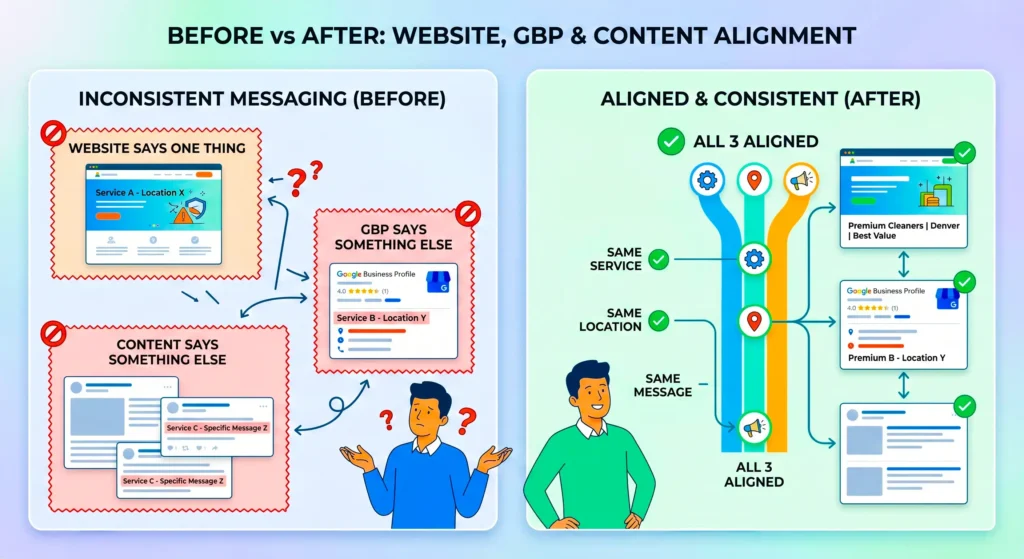
If your website says one thing, your Google Business Profile says another, and your content reinforces neither, you have a problem.
The result is confusion, lower trust, and fewer leads. No need to go pump out more content. That just scales the problem. Align the wording. Find your process and do not change it. Customers usually find your messaging 7 to 12 times before they recognize, trust and act on it. That messaging needs be the same.
Fixing misalignment starts with clarity, not more process.
First, compare your website, Google Business Profile, and content side by side. If they describe your services differently or target different locations, that is where the breakdown is happening. If there are a lot of changes that need to be made, don’t do it all at once. You don’t want to freeze or suspend your Google Business Profile. Instead, just do a few a week if you’re updating the Google Business Profile. If you’re making changes to the website, do a few and submit them for indexing. Don’t submit your whole website, just the pages that you updated.
Use the same language across every platform so there is no confusion about what you offer or who you serve. And really, there are no bonus points for getting fancy here. Keep it simple for your clients. The easier it is for them to scan your website to get the answer they need, the better. If it is easy for clients to read, it’s easy for AI and Search to read as well.
Then, update everything to match. Your website, Google Business Profile, and content should all reflect the same services, locations, and positioning.
Finally, keep it consistent. When you make updates in one place, update the others. Alignment is not a one-time fix. It is something you maintain.