

If your business isn’t showing up on Google Maps, or your Google Maps listing is not showing up in search results, the problem usually isn’t effort.
It’s alignment.
Most businesses think visibility comes from doing more:
More posts. More keywords. More updates.
Google isn’t rewarding activity.
It’s looking for consistency.
Your website says one thing.
Your Google Business Profile says another.
Your services aren’t clearly defined.
Your content doesn’t reinforce your location or expertise.
From Google’s perspective, that’s not a strong business.
That’s a confusing one.
And when Google is unsure, it doesn’t rank you.
This is where most businesses get stuck.
They’re not invisible because they’re doing nothing.
They’re invisible because their signals don’t align.
Once you understand how Google actually evaluates your business, everything changes.
Here’s exactly what’s affecting your visibility:
Google doesn’t rank businesses randomly.
It looks at three core factors:
Most businesses stop there.
That’s where they go wrong.
Because those factors are not evaluated in isolation.
They’re evaluated through signals.
Your Google Business Profile, your website, your content, your reviews, and your activity all work together to tell Google what your business is and where it should show you.
And that “where” matters more than most people realize.
For example:
If your business is based in Columbus but you’re trying to show up in areas like Dublin, Westerville, or Upper Arlington, Google is not just looking at your address.
It’s looking for confirmation across your entire online presence that you actually serve those areas.
If your website doesn’t mention those locations, like Digital Marketing Dublin Ohio, Digital Marketing Westerville Ohio, or Digital Marketing Upper Arlington Ohio,
Google has no reason to rank you there.
This is where most businesses lose visibility.
They assume proximity is enough.
But Google needs reinforcement.
The businesses that consistently show up across Columbus and its surrounding suburbs are not doing more.
They’re doing something more specific.
They’re aligning their signals across both:
And when those two things are clear, Google doesn’t have to guess.
It ranks them accordingly.
And that’s where most businesses fall short. Not effort, but alignment across both service and location.
For example, we’ve seen businesses in Columbus with a fully built website and active Google Business Profile still struggle to show up in nearby areas like Hilliard or Gahanna.
On the surface, everything looked correct.
But when we looked closer:
Once those signals were aligned across both what they do and where they do it, their visibility expanded beyond just their immediate location. We’ve seen businesses go from barely visible to showing across multiple Columbus suburbs like Dublin, Hilliard, and Westerville within weeks once their signals were aligned.
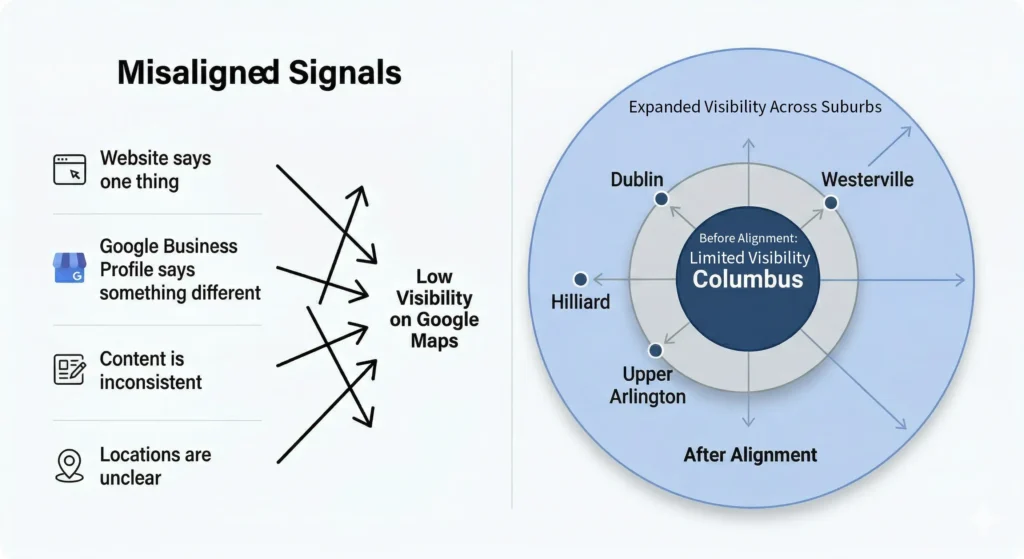
Not because they added more.
Because everything they already had finally worked together.
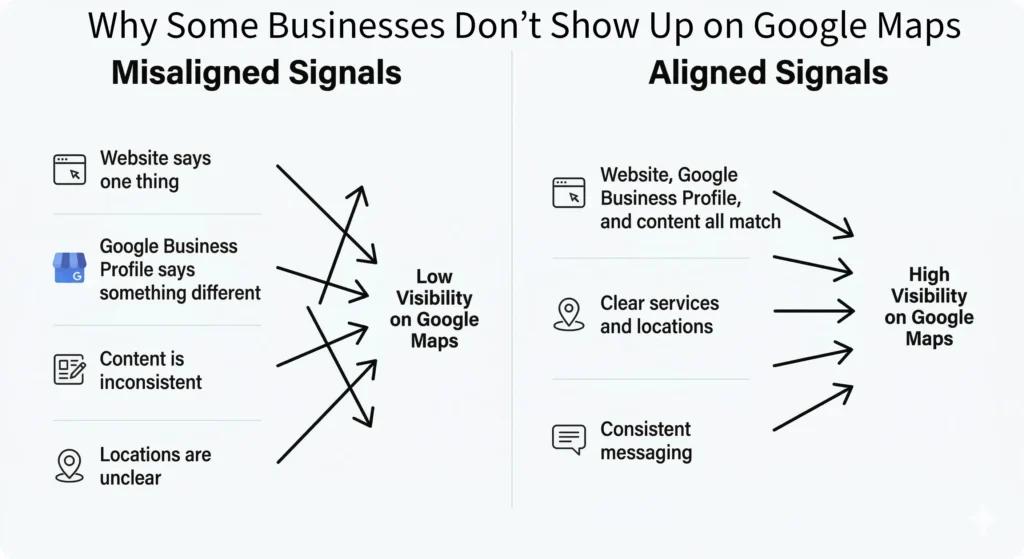
If alignment is the foundation, verification is the starting point.
Because until your business is verified, Google doesn’t fully trust that you exist.
And if Google doesn’t trust your business, it won’t consistently show it.
That’s why unverified profiles often struggle to appear at all, even if everything else looks correct.
Verification isn’t just a technical step.
It’s a trust signal.
It tells Google:
And that matters even more in competitive areas like Columbus and surrounding suburbs.
If you’re trying to show up in places like Dublin, Westerville, or Upper Arlington, but your profile isn’t verified or fully established, Google has no reason to prioritize you over businesses that are.
Once verified, everything else becomes available:
But more importantly, you’ve removed the first barrier to visibility.
Without verification, nothing else you do will have the same impact.
We’ve seen businesses go from completely invisible to appearing in local results within days of completing verification, simply because Google could finally trust the listing.
Here’s how Google typically verifies businesses and how each method impacts visibility:
| Verification Method | Impact on Visibility | Notes |
| Postcard | Essential for GBP verification | Sent by Google to confirm address. |
| Phone | Alternative verification method | Businesses can receive a code via phone. |
| Another method of verification | Some businesses may choose this option. | |
| Unverified GBP | May not appear on Google Maps | Unverified profiles are less trusted by Google. |
| Verified GBP | Increased likelihood of appearing | Can manage information effectively and access features. |
Most businesses don’t think about suspensions until it happens.
By then, it’s already costing them visibility.
A suspension doesn’t just lower your ranking.
It removes you completely.
From Google’s perspective, a suspended business is no longer trustworthy enough to show to users. And once that trust is broken, it takes time to rebuild.
The most common cause is inconsistency.
If your Google Business Profile lists one address, but your website or other listings show something slightly different, Google sees that as a risk.
That’s especially common in areas around Columbus where businesses:
For example, we’ve seen businesses trying to rank in places like Gahanna or New Albany while using an address that doesn’t clearly match their service area.
That mismatch creates doubt.
And doubt leads to suppression or suspension.
Even small differences matter:
Individually, these seem minor.
Together, they create conflicting signals.
And Google doesn’t reward businesses it can’t confidently verify.
The fix is not complicated, but it is precise.
Every version of your business information needs to match:
Because once those signals align, trust is restored.
And visibility follows.
Most businesses think having a Google Business Profile is enough.
It’s not.
Google is not just checking if your profile exists.
It’s evaluating how complete, active, and relevant it is.
An incomplete profile sends a simple message:
This business may not be active.
And inactive businesses don’t get prioritized.
That includes:
But here’s where most businesses misunderstand the problem.
It’s not just about adding more content.
It’s about adding the right content that reinforces your signals.
For example:
If you’re trying to rank in Columbus and nearby suburbs like Hilliard, Upper Arlington, or Dublin, your content needs to reflect that.
That means:
Without that, your profile becomes disconnected.
You might have:
But if none of it reinforces a clear message, Google still has to guess.
And again, when Google has to guess, it doesn’t rank you confidently.
We’ve seen businesses update their profiles regularly but still struggle to expand beyond their immediate area.
Not because they weren’t active.
Because their content wasn’t aligned.
Once their services, descriptions, and updates started reinforcing both their offering and their target locations, their visibility began to expand into surrounding suburbs.
Not instantly.
But consistently.
Because now Google could understand them.
Even if your profile is verified and your content is aligned, there’s another factor that determines how far your visibility can reach.
Local authority.
This is what allows a business to move beyond just its immediate location and show up across surrounding areas.
In places like Columbus, this is the difference between:
Local authority is built through:
But more importantly, it’s built through trust over time.
Google looks at patterns:
For example, a business with:
Will often outrank a business with a similar profile but weaker signals.
Because Google has more confidence in it.
We’ve seen businesses with fewer reviews outperform competitors simply because everything else was aligned and consistent.
That’s how authority works.
It compounds.
And once it’s established, it becomes much easier to expand your visibility into surrounding suburbs.
Not everything affecting your visibility is something you directly control.
And this is where many businesses get frustrated.
You can do everything right and still see fluctuations.
Why?
Because Google Maps results are influenced by:
For example:
A business in a highly competitive area like Columbus may need stronger signals to rank compared to a business in a less saturated suburb.
Or a user searching from downtown Columbus may see different results than someone searching from Hilliard or New Albany.
That’s not inconsistency.
That’s personalization.
Google adjusts results based on context.
This is also why visibility can appear to fluctuate.
It’s not always that your ranking changed.
It’s that the environment around it did.
The mistake businesses make is trying to “chase” these changes.
Instead of focusing on what actually moves the needle:
Clear, consistent signals.
Because while you can’t control the environment, you can control how clearly your business is understood.
And that’s what stabilizes visibility over time.
We’ve seen this pattern play out repeatedly across Columbus and surrounding suburbs.
In one case, a local business operating near Westerville had:
As a result, they were barely visible, even for searches close to their location.
After:
Their visibility improved, not just in Westerville, but in nearby areas as well.
Not because they did more.
Because their signals finally made sense to Google.
At this point, the pattern should be clear.
Every factor we’ve covered comes back to one thing:
Alignment.
Your Google Business Profile, your website, your content, your reviews, and your activity are not separate systems.
They are signals.
And Google is constantly comparing them.
When those signals reinforce each other:
When they conflict:
This is where most businesses struggle.
Not because they’re doing nothing.
But because everything they’re doing is disconnected.
We see this constantly with businesses across Columbus and surrounding suburbs.
They have:
But none of it works together.
Once those signals are aligned, the shift is noticeable.
Not just in rankings.
But in:
Because now Google understands the business.
And when Google understands you, it can confidently show you.
Conflicting signals don’t just slow you down.
They stop you.
If your business information differs across platforms, Google has to decide which version is correct.
And if it can’t, it reduces your visibility.
This shows up in ways like:
For example:
If your Google Business Profile lists one service focus,
your website emphasizes something else,
and your content doesn’t support either clearly,
Google has no clear direction.
And without that, it won’t prioritize you.
The same applies to location signals.
If you’re trying to show up in Dublin, Westerville, or Upper Arlington, but your presence doesn’t consistently reinforce those areas, your reach stays limited.
This is why alignment is not optional.
It’s foundational.
The businesses that consistently show up across Columbus, Dublin, and Upper Arlington are not guessing.
They’ve built a system where:
All reinforce the same message.
That clarity is what Google rewards.
Most of the time, it’s not because your business doesn’t exist.
It’s because your signals don’t align.
If your Google Business Profile, website, and content aren’t reinforcing the same message, Google won’t confidently rank you.
Once your profile is verified and your signals are aligned, improvements can start within days.
But expanding visibility across areas like Columbus, Dublin, or Westerville takes consistency over time.
Yes, but not just for activity.
Your posts should reinforce:
Otherwise, they don’t contribute to visibility.
In most cases, their signals are clearer.
Even if they have fewer reviews or less content, Google understands their business better.
And clarity wins.
If your business isn’t showing up on Google Maps, the answer is not doing more.
It’s doing the right things in the right way.
Start by asking:
If the answer to any of those is no, that’s where to start.
Because visibility doesn’t come from volume.
It comes from clarity.
And the businesses that consistently show up across Columbus and surrounding suburbs are not guessing.
They’ve built alignment into everything they do.
If you want a full breakdown of how this works, you can read our complete guide to local visibility here.
If you’re not sure where your signals are breaking down, we can help.
At Columbus Marketing Experts, we analyze:
And identify exactly what’s holding you back.
From there, we build a clear path to improve your visibility across Google Maps and local search.