

We had a conversation this week with a business about their Google Business Profile.
They asked what they could do to improve it.
The first answers were simple.
Fill out the profile.
Respond to reviews.
Make sure the business name, address, and phone match everywhere.
But that wasn’t the real issue.
The problem wasn’t that they weren’t doing enough.
It’s that nothing they were doing was reinforcing anything.
It was that nothing was consistent.
And when nothing is consistent, nothing compounds.
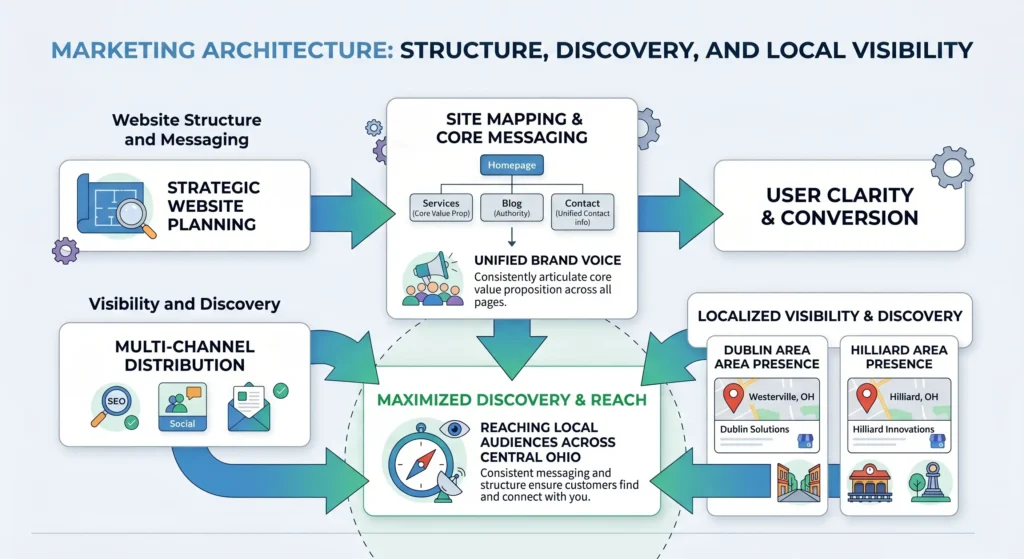
Their website talked about website structure and messaging and visibility and discovery.
Their Google Business Profile wasn’t reinforcing those same services.
And while they were trying to show up in places like Dublin, Westerville, and Hilliard, those locations weren’t being consistently reinforced across their website, their profile, and their content.
We see this constantly around Columbus.
They’re active.
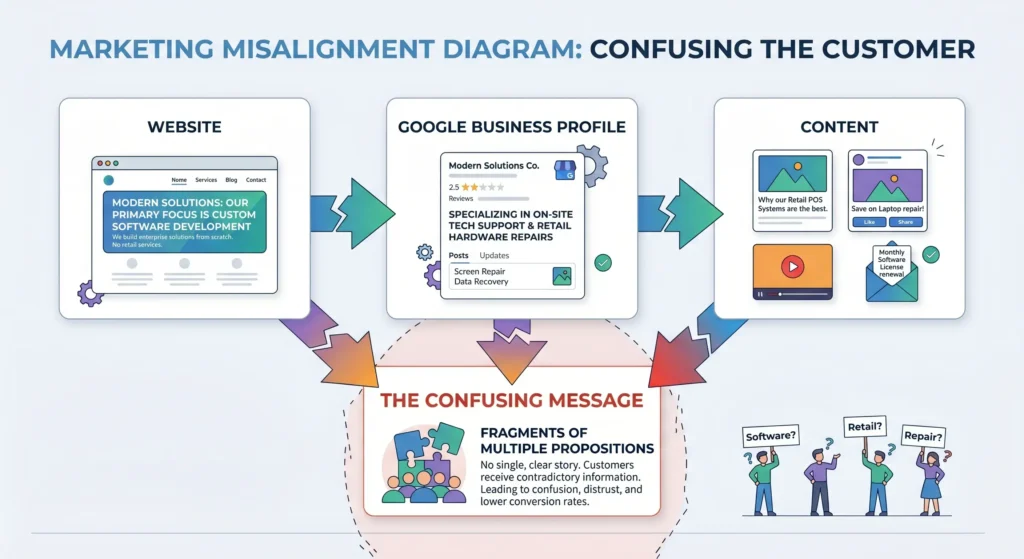
But their website talks about website structure and messaging.
Their Google Business Profile lists services differently.
And they’re trying to show up in places like Dublin, Westerville, and Hilliard without consistently reinforcing those locations across their content.
So instead of building visibility in those areas for those services, everything stays fragmented.
Nothing compounds.
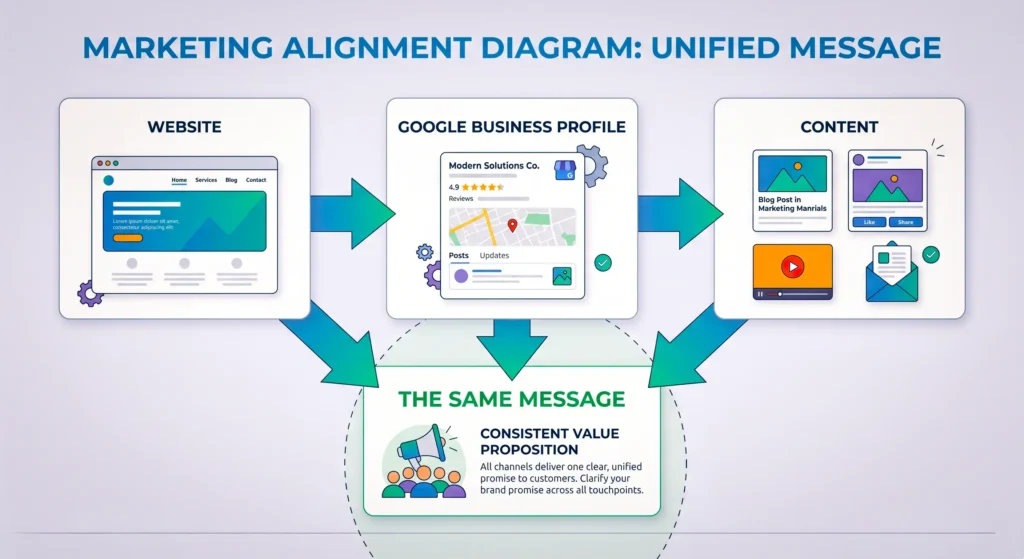
Google doesn’t reward activity.
It rewards clarity.
If your services and locations are clear and consistent across your website, your Google Business Profile, and your content, visibility builds.
If they’re not, it doesn’t.
Different platforms interpret inconsistent data in various ways, affecting your visibility. For instance, if one platform lists your café as a ‘coffee shop’ while another labels it as a ‘restaurant,’ it will confuse algorithms, leading to poor categorization and visibility. You selected an entirely different category to compete in. Now search engines see you claiming different categories and in search engine land, that is a very strong signal that something isn’t right. The same goes for your messaging: inconsistent messaging can dilute your brand identity, making it harder for your target audience to grasp what you stand for.
The stakes are high, when customers encounter discrepancies in your business information, they may share their frustrations in the form of negative reviews, further damaging your reputation. Analyzing competitor strategies often reveals that those who maintain a consistent presence gain a competitive edge. A unified approach across platforms fosters a stronger connection with your audience, enhancing your overall brand recognition and reliability. Consistency helps to establish a clear value proposition, allowing your brand to shine brightly in a crowded marketplace.
Every online platform has its own unique categories that play a crucial role in how businesses are discovered. When a business is misclassified, it risks losing valuable connections with potential customers. This misalignment can cause significant missed opportunities. Consistent categorization across platforms helps search engines correctly index a business, making it easier for customers to find them. When businesses align their services with the right categories, they enhance their discoverability. Understanding the specific guidelines of each platform is essential for proper categorization. By researching how competitors categorize their services, businesses can gain insights into effective strategies. Additionally, staying updated on changes in platform algorithms is vital for maintaining visibility. Regularly updating categories to reflect any changes in services offered ensures that businesses remain relevant. Using consistent terminology across platforms also aids in brand recognition, making it easier for customers to remember and trust the brand. Cross-referencing categories between different platforms can reveal gaps in a business’s market presence, offering opportunities for growth and improvement.
AI thrives on data consistency, making it a critical factor for businesses looking to enhance their visibility. When information about a business varies across platforms, it can lead to misguided AI suggestions that confuse potential customers. For instance, if a café’s name appears differently on Google Maps and its social media, AI systems may struggle to categorize it correctly, leading to missed opportunities in customer engagement. Voice search technology also relies heavily on how well businesses communicate their identity; inconsistent signals can result in AI failing to understand what the business offers. Furthermore, clarity in branding helps AI relay value propositions effectively, while inconsistent information can lead to the generation of incorrect content about a business, further fragmenting its online presence. Monitoring AI interactions is essential, as it can reveal areas in need of more consistency, enabling businesses to adapt and maintain relevance. Regular updates to business information ensure that AI remains current, optimizing the chances of being accurately represented in search results.
AI-generated content can drift away from a brand’s core message if there are inconsistencies in the inputs it receives. For instance, if a company frequently changes its brand guidelines or messaging, AI tools might misinterpret these shifts, leading to content that doesn’t reflect the brand’s values accurately. This misalignment can confuse audiences and dilute the brand’s identity. Without clear direction, AI may produce content that feels off-brand, disrupting the connection with customers. A robust content strategy is essential for guiding AI to focus on key messaging, ensuring that all outputs remain cohesive and representative of the brand. Training AI with consistent data not only improves its understanding but also enhances the overall quality of content. Regular reviews of AI-generated material, coupled with feedback loops, help refine and align the content with the brand’s vision over time. When AI tools operate under well-established guidelines, they can significantly enhance visibility by creating content that resonates with audiences and maintains brand integrity.
Consistent messaging across different platforms can work wonders for a brand. First and foremost, it enhances overall brand recognition and recall. When customers see the same logo, colors, and messaging on your website, social media, and online directories, it sticks in their minds, making your brand more memorable. This recognition is vital in a crowded marketplace. More than just recognition, clear communication builds customer trust. When your messaging is uniform, customers know what to expect, which leads to increased loyalty. They feel confident in their choice and are more likely to return. Uniform branding also strengthens customer relationships. It creates a sense of belonging and familiarity, which fosters deeper connections. Moreover, consistent content encourages user engagement. When customers encounter the same messages, they are more likely to interact with your brand, whether through comments, shares, or likes. This engagement can drive your marketing strategies, as it leads to more effective outreach. Consistency can also impact your bottom line. Brands that maintain uniform messaging typically see higher conversion rates. Customers are more inclined to make purchases from businesses that present reliable and trustworthy identities. Additionally, a consistent message simplifies customer decision-making. When customers know what your brand stands for, they can make quicker decisions. This clarity is essential in today’s fast-paced digital environment. A cohesive brand identity can help you stand out from competitors by clearly differentiating your offerings. Finally, building a strong online identity through consistent messaging can lead to positive word-of-mouth, as satisfied customers are more likely to refer businesses they trust.
Aligning services with your messaging can be a game-changer for visibility. When your service offerings are clear and consistent across all platforms, potential customers know exactly what to expect. This clarity not only builds trust but also enhances your credibility. Imagine a graphic design agency that describes its services the same way on its website, social media, and Google Business Profile. This consistency signals to customers that they can rely on the agency for a unified experience, boosting their confidence in choosing that service.
Moreover, marketing strategies should reflect these aligned service offerings. A strong, coherent message across all platforms creates a seamless experience for customers and reinforces your brand identity. Regularly updating service information keeps customers informed and engaged. If a salon introduces a new hair treatment, sharing that news across all platforms ensures that no one misses out.
Customer feedback is another critical component. Engaging with customers can help refine how well your services align with your branding. When customers feel heard, it fosters a sense of community and loyalty, making them more likely to return and refer others.
Cross-promoting your services on various platforms can also drive visibility. If you highlight unique offerings consistently, like a catering service specializing in vegan options, you are more likely to attract attention. A well-aligned service approach not only amplifies your visibility but can also lead to increased referrals, as satisfied customers share their experiences with friends and family.
Trust is a crucial element in any customer relationship, and it is built over time through consistent experiences. When a brand maintains a reliable online presence, it encourages customer confidence, making them feel secure in their choice. Consistent messaging across all platforms reassures customers about the brand’s reliability, allowing them to form a strong connection with what the brand stands for.
Transparency in communications plays a vital role in fostering trust and loyalty; customers appreciate brands that keep them informed and engaged. Furthermore, businesses that consistently deliver quality products or services are more likely to retain customers, as people gravitate toward brands that they know they can rely on. When brands respond consistently to customer inquiries, they build rapport and demonstrate their commitment to customer satisfaction.
Sharing success stories regularly enhances brand trustworthiness, showing potential customers that others have had positive experiences. Engaging with the audience through regular updates fosters a sense of community, enabling customers to feel like they are part of something bigger. A trustworthy brand often benefits from word-of-mouth recommendations, as satisfied customers are eager to share their experiences. Lastly, consistency in values and mission strengthens brand integrity, reinforcing the idea that the brand stands for something meaningful. This all adds up to a powerful narrative that enhances visibility and trust in the crowded digital marketplace.
If your services and locations aren’t consistent, Google doesn’t have anything clear to rank.
So it doesn’t.
The fix is not doing more.
It’s making sure everything says the same thing.
The same services.
The same locations.
The same positioning.
Across your website, your Google Business Profile, and your content.
That’s what creates clarity.
And clarity is what builds visibility.